- Ad Peak
- Posts
- The Marketing Maturity MountainTM: Framework for Sustainable Growth
The Marketing Maturity MountainTM: Framework for Sustainable Growth

Ad Peak
December 17, 2024


Does the world really need another marketing framework?" is probably what you are asking yourself.
I understand.
funnels.
flywheels.
matrixes.
maps.
models.
a hierarchy.
Abbreviations.
The list is endless.
However, there is currently no growth strategy that can transform a fledgling business into a market leader.
Because market penetration is the most crucial growth lever of all, and it is typically overlooked by growth frameworks.
Better yet, not many growth frameworks let you expand in a sustainable way, which means you do not have to spend a fortune doing it.
The lever that marketers and brands struggle with the most is, predictably, market penetration, or selling to a larger portion of your total addressable market (TAM) over time.
We came to the conclusion that, in the modern world, being a strategic partner—and a proactive one, for that matter—required a framework that could address a wide range of issues after conducting many client interviews, compiling data from our various clients, and doing reputable marketing research.
For example: Short-term objectives
Repairing ad platform revenue leakage and other marketing initiatives Using marketing to create real business impact (increasing revenue, profit, pipeline, etc.) Increasing LTV:CAC proportions Resonating through better posture and message A better comprehension of your business's marketing path and upcoming initiatives etc.
Longer-term objectives:
Creating competitive advantages and a good competitive position expanding market share Taking the lead in a category, etc.
We created our Marketing Maturity MountainTM, a sustainable growth framework that, for the first time, plots the five core maturity stages a business and its marketing must go through to increase market penetration and sustain growth over the long term, in order to address almost EVERY problem a marketer faces, regardless of the stage the company is in.
Additionally, that enables you to address any objective you may have for today, be it a marketing activity goal (cost per conversion, cost per click, etc.) or a business goal (revenue/profit).

Furthermore, we are deconstructing the meaning of the growth stages and including:
Definition: What it means to be in a certain mountain stage.
Goal: What we hope to accomplish at this point.
Penetration Level: We will demonstrate how your buying pool grows over time until you sell to the majority of your TAM, if not all of them.
Marketing Activities: During a certain stage of the mountain, you would concentrate on the following marketing activities:
Demand Generation vs. Demand Capture
Paid advertisements (social, search, etc.)
Optimization of Conversion Rates Partnerships in Account-Based Marketing Brand advertising, product marketing, etc.
KPIs: These are the key performance measures, broken down by marketing activity, that you would wish to enhance throughout that phase (for instance, Google Ads will have different KPIs than ABM).
Triggers are the KPI ranges you should reach before you know you are prepared to move on to the next Marketing Maturity MountainTM stage.
Here is a more comprehensive summary so you can see how everything is organized:
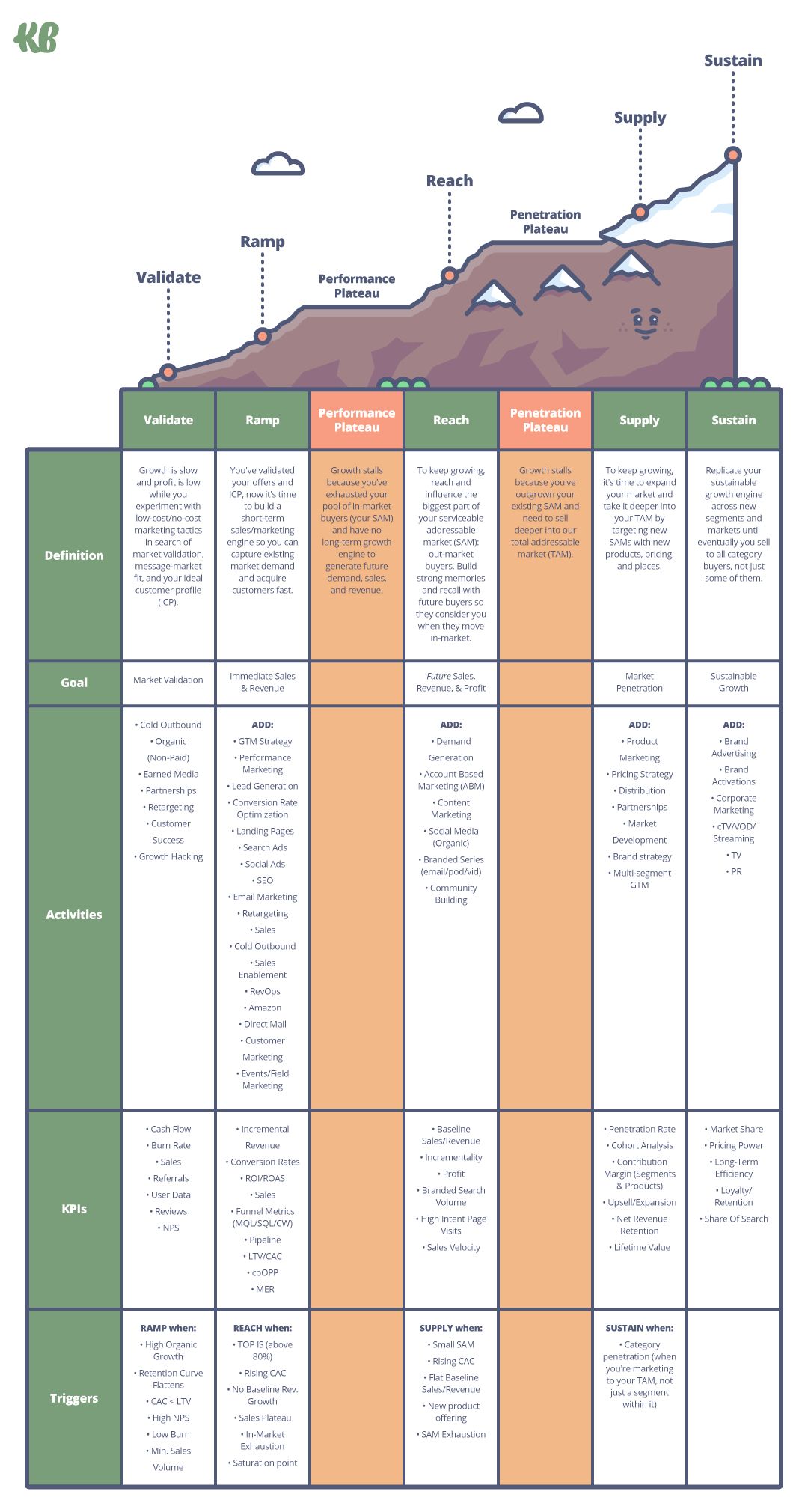
The Marketing Maturity MountainTM can be compared to a video game.
In order to obtain experience (the KPIs) and advance to new levels (the triggers), you concentrate on quests (the marketing activities).
Oh, and did we mention that your larger business impact goals (profit and/or revenue) will be reflected in every marketing activity, KPI, and trigger on the Marketing Maturity MountainTM?
Are you prepared to ascend?
Small markets that offer quick, effective growth have captured the attention of companies more and more over the past ten and a half years, at the expense of larger markets that offer slower, more sustainable growth.
One or more of the following could describe it:
Giving in-market purchasers priority (5%) rather than out-of-market purchasers (95%)
Demand generation versus performance marketing
Prioritizing current revenue over future revenue
Target markets (1:All) versus target accounts (1:1).
Prioritizing current clients over prospective ones.
Segments of niches over general categories.
For the goal of increasing efficiency, we are gradually reducing our buyer pools rather than growing them. When those dwindling pools run out of buyers (or fill up with too much competition), we will enter a growth plateau.
Because there are so many businesses vying for just the 5% of in-market shoppers, they
find it quite difficult to stand apart from rivals in the long run. Reach growth stalls more quickly Because you and everyone else are competing in a much smaller market of customers, you suffer from growing CACs.
We are not arguing that tiny markets are unimportant or incapable of generating growth.
They do.
Furthermore, it is difficult to envision a successful marketing campaign that disregards existing clients, target accounts (B2B), in-market purchasers, instant revenue, and specialist markets.
However, small buyer markets are just that—small.
Additionally, they have little to no scalability and/or quickly dry up.
Additionally, when they do, sales decline.
The answer?
Growth resembles a ragged mountain edge with peaks, valleys, and sporadic plateaus rather than a straight line "up and to the right" (hence the mountain metaphor).
Our definition of "sustainable growth" is therefore not hockey stick growth without pause, but rather a rough mountain edge with peaks and valleys and a constantly growing summit.
From current consumers to new ones, in-market to out-of-market, niche segments to all category buyers, brands must gradually broaden their pool of prospective customers until they sell to all category buyers (the top of the mountain).